Predictive Integrity Engine — Edmonton, Alberta

We detect failure
before
it happens.

"We detect when systems stop telling the truth — before people pay the price." — Alexander Kalyniuk, Founder, FSME Logic
0
Lead time
ESA spacecraft
0
Hour warning
NASA Curiosity Rover
0
Fleet detection rate
509 jet engines
0
False positives
full baseline window
FSME Assistant is online. Ask if your data format is compatible ↘

No infrastructure required  ·  Same-day results  ·  Data never leaves your facility

Standard monitoring
only sees the crash.

Threshold alarms fire when a value exceeds a preset limit. By the time the alarm sounds, the damage is already in progress. The warning window has already closed.

How to predict equipment failure: Alarms, not answers.

Standard sensors tell you when something has already gone wrong. They trigger on amplitude spikes — the symptom, not the cause. Maintenance teams respond to emergencies instead of planning ahead.

Why unexpected shutdowns happen: The Green Dashboard Fallacy.

A system can show perfectly normal readings right up until failure. Internal structural degradation is invisible to threshold monitoring — no spikes, no alerts, perfectly healthy on every dashboard — until it isn't.

Predictive maintenance without the cloud.

Most AI-based predictive platforms require your operational telemetry to be uploaded for processing. Your data leaves your facility. For industrial and fleet operations, that's an unacceptable security exposure.

We read the history
your sensors ignore.

Physical systems accumulate stress over time. That stress leaves a measurable trace in the signal record. FSME Logic reads that trace — identifying structural degradation weeks or months before any threshold alarm would trigger.

📡

Offline Predictive Maintenance: Beyond Thresholds

We detect the earliest signs of structural stress accumulation in your signal record — long before any visible symptom appears.

🔒

Air-Gapped Analysis: Zero Data Exit.

All analysis runs on local, air-gapped hardware in our Edmonton facility. Your data is never uploaded to any cloud server or transmitted over any network. SHA-256 custody receipt included.

No Historical Failure Data Required

Most AI maintenance platforms need months of failure data before they can operate. FSME Logic deploys cold — on any new asset, from the first day of operation.

📋

Works With Existing SCADA Exports

No new sensors. No new hardware. No infrastructure changes. We work directly from your existing SCADA, BMS, or data logger CSV exports.

🏭

Any Industry, Any Asset

Validated across aerospace telemetry, commercial vehicle fleets, industrial bearings, refrigeration systems, and orbital satellite hardware.

📊

Plain-Language Reports

Every audit delivers a clear, actionable summary — which systems showed early warning indicators, what the stress timeline looks like, and what action is recommended. Written for operations managers, not physicists.

Offline predictive maintenance: The difference between detecting failure and preventing it.

Standard monitoring waits for something to go wrong. FSME Logic detects the structural signatures that precede failure — identifying the point where a system's signal record begins deviating from its own history.

The result is a planning window measured in hours, days, or months — not seconds. Time to schedule maintenance, order parts, and prevent unplanned downtime entirely.

See Validation Data ▸
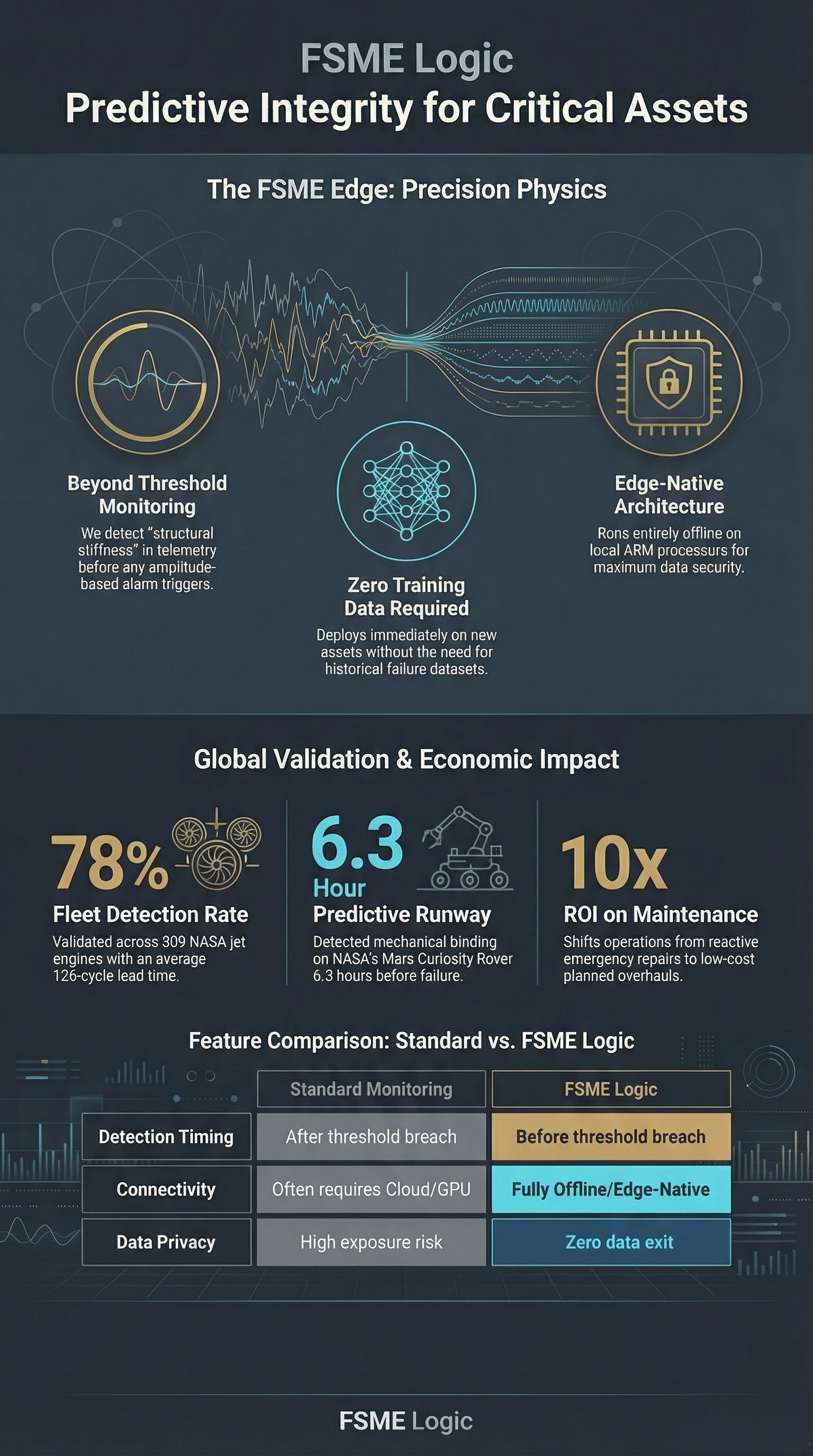
FSME Logic — Predictive Integrity for Critical Assets

Tested on the world's
hardest datasets.

Produced on offline edge hardware. No cloud compute. No GPU clusters. No training phase. Every result confirmed against official ground-truth labels after detection.

ESA Anomaly Detection Benchmark
9 mo
Predictive Lead Time

Detected a four-channel spacecraft subsystem cascade 9 months before the first officially recorded ESA ground truth anomaly.

NASA Mars Science Laboratory
6.3 hr
Warning Before Failure

Detected mechanical actuator binding on the Curiosity Rover 382 steps before NASA's official failure label.

NASA C-MAPSS — 509 Turbofan Engines
78%
Fleet Detection Rate

Successfully identified degradation across 509 commercial turbofan engines with an average 126-cycle warning advantage.

Want to see the full NASA, ESA, CWRU, and refrigeration results?

View all validation data →

What degradation actually
looks like.

Select your equipment type and operating hours. The visualization simulates the signal signature FSME Logic reads — showing the early stress pattern that appears long before any threshold alarm would trigger. Based on real benchmark degradation profiles.

Signal
FSME Detection Point
Threshold Alarm

Simulation note: Signal patterns are based on real degradation profiles from published benchmark datasets (CWRU Bearing, NASA C-MAPSS, LIGO O3b, and proprietary refrigeration measurements). Displayed waveforms are illustrative simulations, not live sensor output. Actual detection lead times vary by equipment type and data quality.

Export. Audit.
Report.

01

Export Your Data

Pull a CSV from your existing monitoring system. 30–90 days of sensor readings is ideal. No special format required — SCADA, BMS, or data logger output all work.

02

Send to FSME Logic

Transfer your data file to us securely. All analysis runs on our local, offline hardware in Edmonton — no internet connection, no cloud uploads. We do not store your data.

03

Forensic Report

A comprehensive summary identifying which systems showed early warning indicators, what the stress timeline looks like, and what action is recommended.

04

Custody Receipt

A SHA-256 cryptographic chain of custody document confirming your data was handled securely and never transmitted at any stage.

Ready to see what your
sensors are missing?

Book a Pilot Integrity Audit. Fully offline, no new infrastructure required. Results delivered the same day.

Book a Pilot Audit ▸ Review Validation Data
// LATEST FROM FSME LOGIC

Watch It In Action

// FSME Logic YouTube

Follow the build — the validation results and the launch.

Behind-the-scenes engineering, validation walkthroughs, and the story of building FSME Logic from consumer hardware in Edmonton.

View Channel ↗